Brand differentiation is more than being different.
This is a lesson I teach in the live workshops I run for communities, business associations, and economic development organizations.
Being different for the sake of being different is just plain stupid.
Think about it.
I could show up to every workshop I run dressed as a clown.
That’s different. No other brand strategist on the face of the planet dresses like a clown when working with their clients. I would be the only one.
But being different just to be different misses a key component of differentiation:
Differentiation has to matter to your ideal customers.
If they don’t care about it, they won’t buy it.
And the whole purpose of differentiation is to get people to choose your offer.
What is Differentiation?
Most marketers and branders define differentiation as highlighting the unique value that makes your business stand out from the competition.
It’s a decent definition, but doesn’t truly capture what differentiation is all about.
Differentiation is the real reason customers choose you, and the thing your customers resonate most with in your business.
Think about it.
When you evaluate two businesses that offer different solutions to the same problem, priced about the same, how do you choose which one to go with?
It’s not price. It’s not personality. It’s likely not the design of their website.
There’s something that draws you to one over the other.
For most people, it’s often the methodology of solving the problem:
- how the company operates
- the process they follow
- their deliverable
Something they do that resonates with you.
That something is their differentiator — because it’s the reason you choose them over the competition.
Presenting a Choice
That’s what most businesses get wrong about differentiation:
It should present a choice to their ideal customers.
Choose our way of doing things or choose the competition’s way of doing things.
Take Tesla, as an example.
When they entered the EV market, every business was putting out the same type of product: boring, small, slow sedans.
I remember when the Toyota Prius first came out. I was living in rural Illinois at the time. Pickup trucks and SUVs were the norm.
The Prius looked and sounded like a toy — and people who bought one were often made fun of.
Tesla did something different.
They didn’t reinvent the automobile or come in and try to create a whole new category. They decided to give the market a choice:
Either buy a boring, small, slow sedan OR buy a stylish, fast sports car.
In Elon’s letter to Tesla employees in 2006, he stated:
The strategy of Tesla is to enter at the high end of the market, where customers are prepared to pay a premium, and then drive down market as fast as possible to higher unit volume and lower prices with each successive model.
So, in short, the master plan is:
1. Build sports car
2. Use that money to build an affordable car
3. Use that money to build an even more affordable car
4. While doing above, also provide zero emission electric power generation options
Tesla operated differently, and now that they are on steps 2 and 3, that mindset of being different still sticks.
Tesla Sedans are more stylish, faster, and fun than any other EV sedan on the market.
They gave the market a choice — one their ideal customers resonated with on a deep and foundational level.
Service Business’s Choice
Tesla’s example makes sense if you’re selling a product. But what if you sell a B2B service?
The same principles apply.
Take Shft as an example.
Most brand agencies focus heavily on design — logos, fonts, colors, patterns, websites.
Just take a look at their websites. Portfolios are front and center because they want to show you what they’ve designed.
Everything they do, from strategy to content, revolves around design. Sign up for their brand strategy, and you basically get a brief to guide their design team.
- They brand your why — who you are and how you want to look.
- Shft brands your how — what you actually do, not who you are.
That difference might seem subtle, but it’s huge.
Our ideal customers are highly technical. They’re manufacturers, developers, coders, and often in or servicing the industrial space.
They know processes, are incredibly intelligent, and are leery of froo-froo vibe branding that focuses on values and personality.
They want a system they can follow to get the results they’re after.
So, I structured our agency to work for them: less personality adjectives and archetypes and more operational and systematic branding.
Shft gives clients a choice: if you want personality adjectives, archetypes, and a fancy deck that looks good, we aren’t for you.
But if you want a system you can implement that helps you understand what makes your business unique, who your offer is for, how to communicate it, how to create an experience around it, and how to attract and convert those customers, Shft is for you.
Differentiation is a choice that matters to your ideal customers.
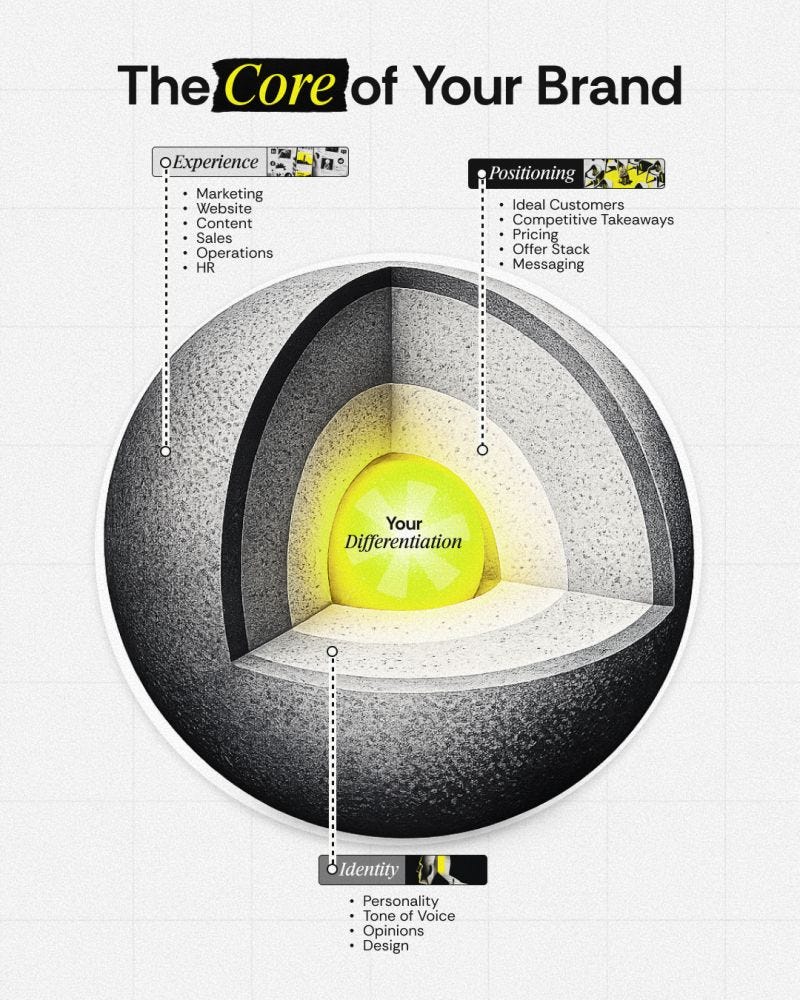
The Core of Your Brand
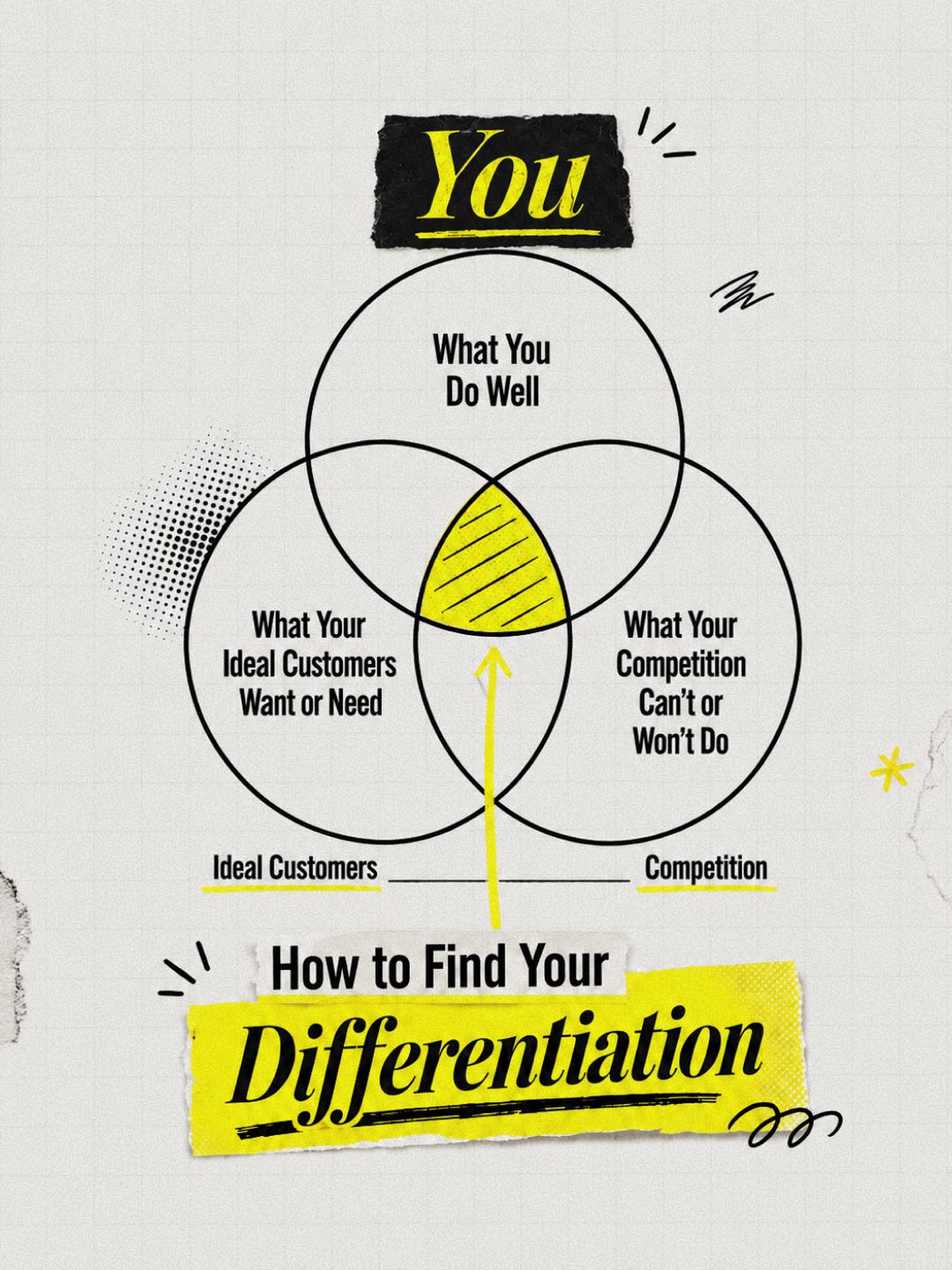
Your differentiation is found at the intersection of:
- What you do exceptionally well. It has to be something you can deliver on 99.99% of the time.
- Your competitors can’t or won’t do. It has to be something your competitors either can’t physically do (lack of resources) or won’t do (goes against who they are).
- Your ideal customers want or need it. It has to be something your customers are willing to pay for.
For a service-based business, that means it’s found in your:
- Processes
- Operations
- Deliverables
The things you do while solving your customer’s problems.
It’s about finding one thing you do differently and making that everything:
- Highlighting it in your messaging
- Focusing on it in your content
- Wrapping your operations around it
- Embedding it into your sales process
- Creating an experience that helps people feel it
When implemented correctly, it becomes the core of your business and your brand.
Find Your Differentiation
I’ll be honest: finding your differentiation is not easy.
Most owners never fully nail down what makes them unique, because they are too close to the business to objectively see their unique value.
I can’t begin to tell you how many founders I’ve worked with who truly had something that made them unique, but they saw that differentiator as boring, typical, and unremarkable.
Hell, I help companies uncover their differentiator for a living, and even I struggled to find it for Shft.
This process is not easy.
But I’ve put together a few resources that can help you uncover your differentiator if you’re willing to put in the work:
- Find Your Differentiation Email Course: A free, 7-day email course that teaches the fundamentals of differentiation and gives you exercises to uncover it.
- Uncover Your Differentiator Course: A paid course walking you through how to find your differentiation. Includes free Miro Whiteboard with exercises to work through.
- Strategy Workshop: A 90-minute, one-on-one workshop with me to uncover your differentiation and come up with ideas to help people feel that differentiator in your messaging, marketing, sales, and operations. Includes 1-month access to WhatsApp for feedback and questions.
- Brand OS: The complete system to uncover and own your differentiator through messaging, marketing, sales, operations, and design. Includes systems and AI markdown files to help you implement your strategy.
Any of them will help you figure out what makes your business different.
You just have to choose how much access you want to my experience and brain.
Until next week,
#SassyJason out.
✌🏼