How well you know your ideal customers determines your business’ success.
Most founders (and marketers!) say they know their ideal customers — and prove it by prattling off a list of demographic information.
Job title, industry, revenue, business size, business type, buying committee members, age, education level, ownership style…the list goes on and on.
The more progressive business owners even include psychographics: hobbies, interests, beliefs, books, podcasts, and influencers they follow.
For most B2B companies, demographics and psychographics are the epitome of knowing your ideal customers.
But having a customer persona filled with demographic (job title, industry, business size, revenue) or psychographic (hobbies, interests, personality) information is not enough.
You should be able to describe the key attributes of your ideal customers in under 1 minute.
If not, you don’t know them as well as you might think — and are likely making assumptions in your marketing and sales efforts that are costing you big.
Why Demographics Are Not Enough
Don’t get me wrong, demographics are important.
You need information such as job titles, revenue, and business size to target your ideal customers across most ad platforms.
Even LinkedIn ads, arguably the best platform at targeting, require demographic information.
But demographics don’t give you a clear picture of who your ideal customers are.
Don’t believe me?
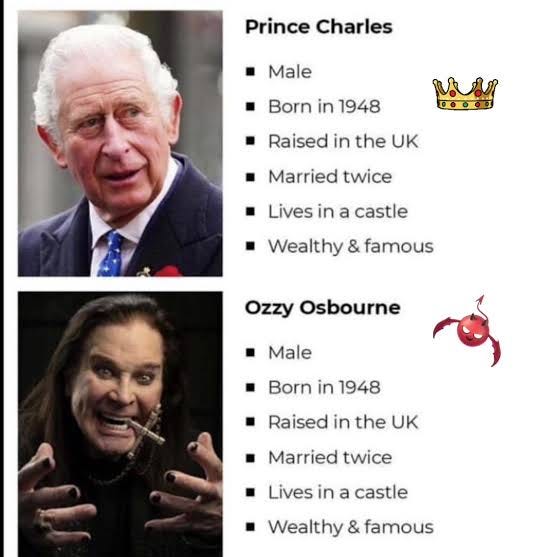
Take this popular meme of King Charles vs Ozzy Osbourne.
According to their demographic information, King Charles and Ozzy fit in the same category.
But anyone with half a brain knows that the messaging, marketing, service, operations, and sales process to attract them will be wildly different.
Just because someone has the right job title doesn’t mean they are an ideal customer.
You need more information to know if they are actually a true fit.
Customer DNA Framework
I could give you a full list of everything you should gather about your ideal customers, but that would make this email far too long and way too boring.
And, let’s be honest, you wouldn’t remember all of it anyway when you sit down to write content, create ads, or tweak your offer.
That’s why we create what I call Customer DNA for our clients.
The Customer DNA Framework includes 5 simple attributes that define your ideal customers.
Knowing (and memorizing) these 5 attributes will help you:
- Create content they need
- Craft messaging that resonates
- Design ads that grab their attention
- Develop an offer they can’t say NO to
- Send outbound messages that are relevant
- Show up where they are with the right message
Ultimately, create a marketing plan that attracts and converts them.
Here are the attributes you need to know:
Title & Company
Clearly define the job title and company of your ideal customers.
Example: Founders and CEOs of 7-8 figure B2B companies in the industrial or professional services space.
Defining Characteristic
Explain the main characteristic that helps identify that they are a good fit. This could be anything, but it should be true of every ideal customer.
Example: Experiencing revenue stagnation and have tried everything to reverse it.
Resonating Mindset
Define the mindset they need to resonate with the solution you provide.
Example: Fed up with marketing agencies that don’t deliver results and want to build their business the right way.
Challenge or Limitation
Define what is ultimately limiting them from solving their problem.
Example: Don’t know what makes their business unique or how to communicate it well.
Ideal State
Define what they are hoping to achieve — the ideal state they want to get to in their business.
Example: Become the only choice for their ideal customers, generating high-intent, quality leads that convert.
Commit Your DNA to Memory
Let’s be honest: no one on your team will pull up a customer persona when trying to create LinkedIn content, ad copy, or tweak your offer.
We don’t even do that here at Shft.
That’s why I created the Customer DNA Framework.
A full customer profile is hard to remember. The profiles we create for our clients can be 10 pages long — all good and necessary information to know who they are and how they buy, but maybe a little overkill when writing a LinkedIn post.
Customer DNA distills the core of those 10 pages into something easy to remember.
That way, when your marketer is writing ad copy or your salesperson is tweaking the pitch deck or your operations manager is tweaking your automations, they are keeping your customers front and center.
Which is what a good customer profile should do.
Start with Your Customer Profile
Defining your Customer DNA starts by creating the right customer profile.
- Document what you already know about your customers
- Interview them to verify or adjust what you know
- Research them to uncover what truly matters
- Document everything you find into a Customer Profile
I created one we use when developing strategies for our clients.
Be warned: this is no HubSpot customer persona template.
It’s an extensive file that helps you understand the nuances and nitty-gritty of your ideal customers, so you can better attract them.
I put it in a Google Doc along with a dummy profile so you know what to fill out.
Grab your Customer Profile Template here for $0.
Or, keep using a subpar profile that requires you to test every single thing you do.
That’s an option, too, I guess.
Until next week,
SassyJason out.
✌🏼