Positioning starts by knowing your competitors.
You’ll never own a unique place in the minds of your ideal customers if you don’t know what already exists in the market.
Is your process truly unique?
Is your business really differentiated?
Is anyone else making the same claims as you?
If you don’t have a pulse on what your competitors are doing, you will end up looking and sounding just like them.
That’s why every positioning project should start with competitive research.
But don’t jump into Claude and ask it to do competitive research just yet.
There are specific insights you need to create a unique position in the market.
Be Unique or Blend In
Most businesses try to look and sound like their industry, but the goal of positioning is to stand out and be different.
Competitive research helps you uncover the insights to actually be different.
Take the image below.
When you try to position your business as “the best” or to look and sound like the industry, you blend in.
Same message. Same promise. Same overall look and feel.
That makes it hard for customers to choose you.
But when you know how your competitors are positioned, how they look and sound, the promises they make, you have the foundation to be unique — and own a unique position in the minds of your ideal customers.
That makes it easier for them to choose you.
So, the goal with competitive research is not to copy or steal, but to know how to be different.
Insights to Uncover
Here are some key insights we aim to uncover when conducting competitive research for our clients.
Positioning
Uncover the position your competitors are trying to own in your ideal customers' minds. This will tell you what position not to own.
How to find it:
- Scrape messaging from your competitors’ websites
- Look for repeated messages and themes
- Uncover any unique points of view in their content
- See how they explain the problem they solve
- Uncover how they talk about their offer
All of those will help you understand what they are trying to be known for.
Awareness
How well do buyers know your competitors, and how do they learn about them?
Uncovering your competitors’ brand awareness will help you understand what you’re up against, marketing-wise.
There are countless ways to measure brand awareness, but for competitive research, we rely on SEO and trend metrics.
How to find it:
- Use SEMrush to pull these metrics: top-ranking keywords, authority, organic traffic, intent, organic keywords, backlinks, and referring domains.
- Use Google Trends to see awareness levels over time for your competitors.
- Use AI to uncover competitor mentions in industry publications, associations, and organizations.
This is a simplistic way to gauge awareness, but it will tell you how buyers are finding your competitors’ websites (social, Google search, AI search, an industry directory), how often your competitors are mentioned by authority sources, and how often buyers are searching for your competitors.
All of this will help direct your marketing efforts.
Design
Most businesses within the same industry will look and sound the same. It’s almost as if they use the same templates and playbooks to build their brand identity.
Knowing the design elements your competitors use will help you stand out so your brand is memorable.
How to find it:
- Pull up competitor websites and document: main color palettes, font styles, imagery styles, and any patterns or icons they use.
- Look at social media accounts and document the video, picture, and graphic styles.
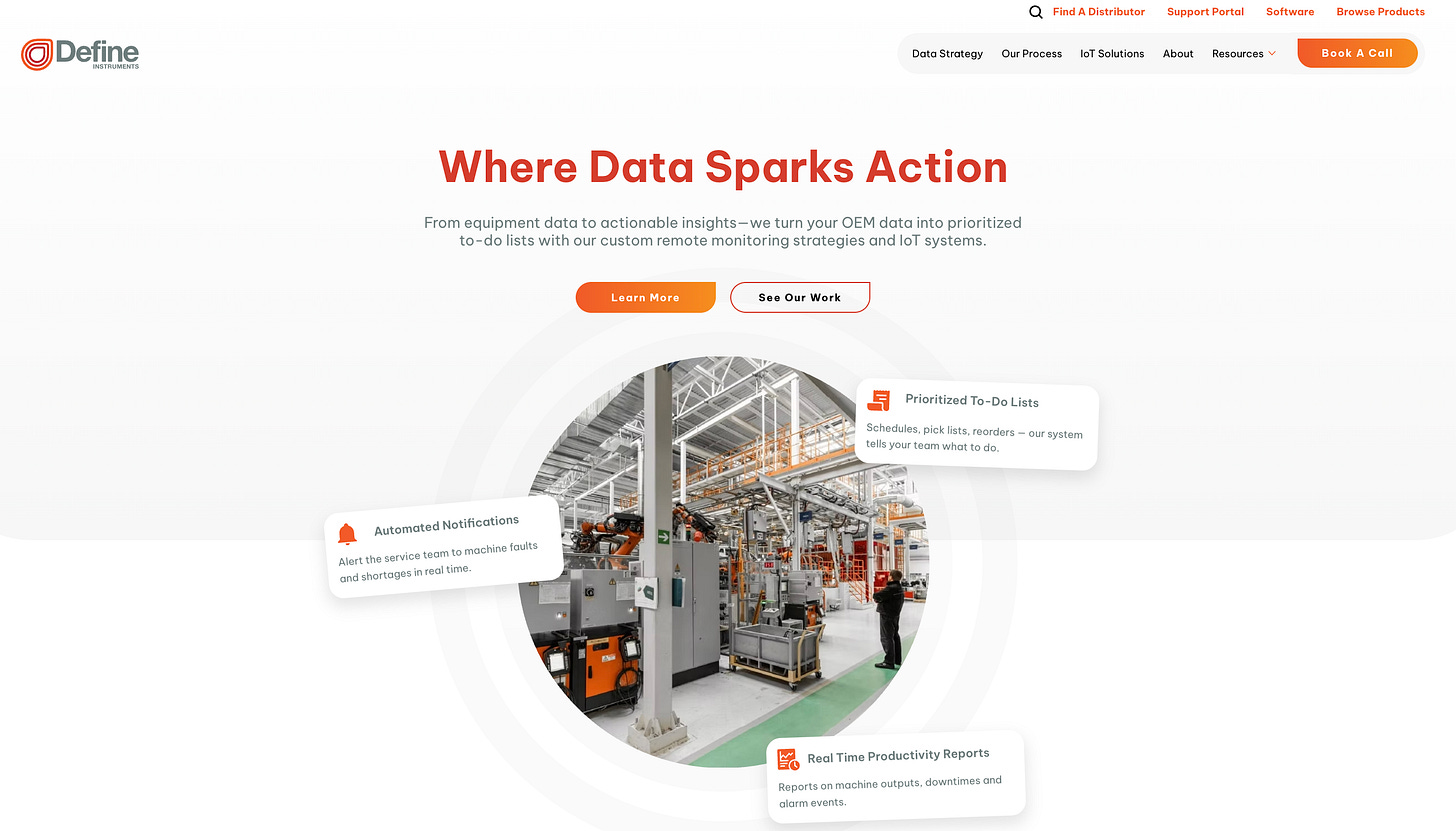
Take a look at one of our clients, Define Instruments.
When we researched their competitors (IoT remote monitoring companies), we found that most used a blue color palette and the same technical lines and dot images.
We avoided those in their brand design — choosing an orange color palette and industrial images that reflect their clients.
Marketing
Lastly, you need to understand how your competitors market themselves.
How to find it:
- Find and document their social media accounts, follower counts, content styles, and engagement.
- Review their blog posts, lead magnet, email newsletter, and podcast for points of view, styles, and topic focuses.
- Evaluate their case studies for depth, results, how many they have, and how well they use them on social media.
- Access ad libraries and find any social ads your competitors are running.
- Use AI to uncover ads, editorials, and sponsorships your competitors are running in industry-specific publications and organizations.
- Scrape their websites and social media for any events they attend, such as trade shows, conferences, and webinars.
This information will help you understand how to market your own business — not just doing what they do, but finding ways to be different.
For instance, if every competitor puts out announcement-style blog posts, you should create more practical, how-to content.
How to Use These Insights
Once you understand how your competitors are positioned in the market, it’s time to use those insights to stand out and be different.
There are a few different frameworks that can help.
Do the Opposite
The simplest way to stand out is to do the opposite of what every competitor is doing, within reason.
Look at how they position and market themselves and ask: Is the opposite viable for us?
If every competitor tries to position themselves as the best, position yourself on something else.
If every competitor hosts webinars, you create a podcast.
If every competitor uses a blue color palette, you use orange.
It’s not a direct opposite (don’t position yourself as the worst!), the goal is to distance yourself from what they do.
Do it Differently
There are some things you won’t be able to avoid.
Take social media — like it or not, being active on social is a non-negotiable for most industries.
You can’t just avoid it because your competitors are there. So the opposite doesn’t work.
In that case, you need to show up differently.
See how they show up on that platform, and find ways to stand out. If their content is all feature announcements, you create practical, actionable content.
Be there, but be different.
Align with Your Position
In either case, what you do should align with the unique position you want to hold.
Take Shft, for instance.
We’re positioning ourselves with the phrase “brand your how, not your why.”
That’s why our content is highly actionable, sharing frameworks, methodologies, and templates — and why we have strong points of view about branding.
It fits our position.
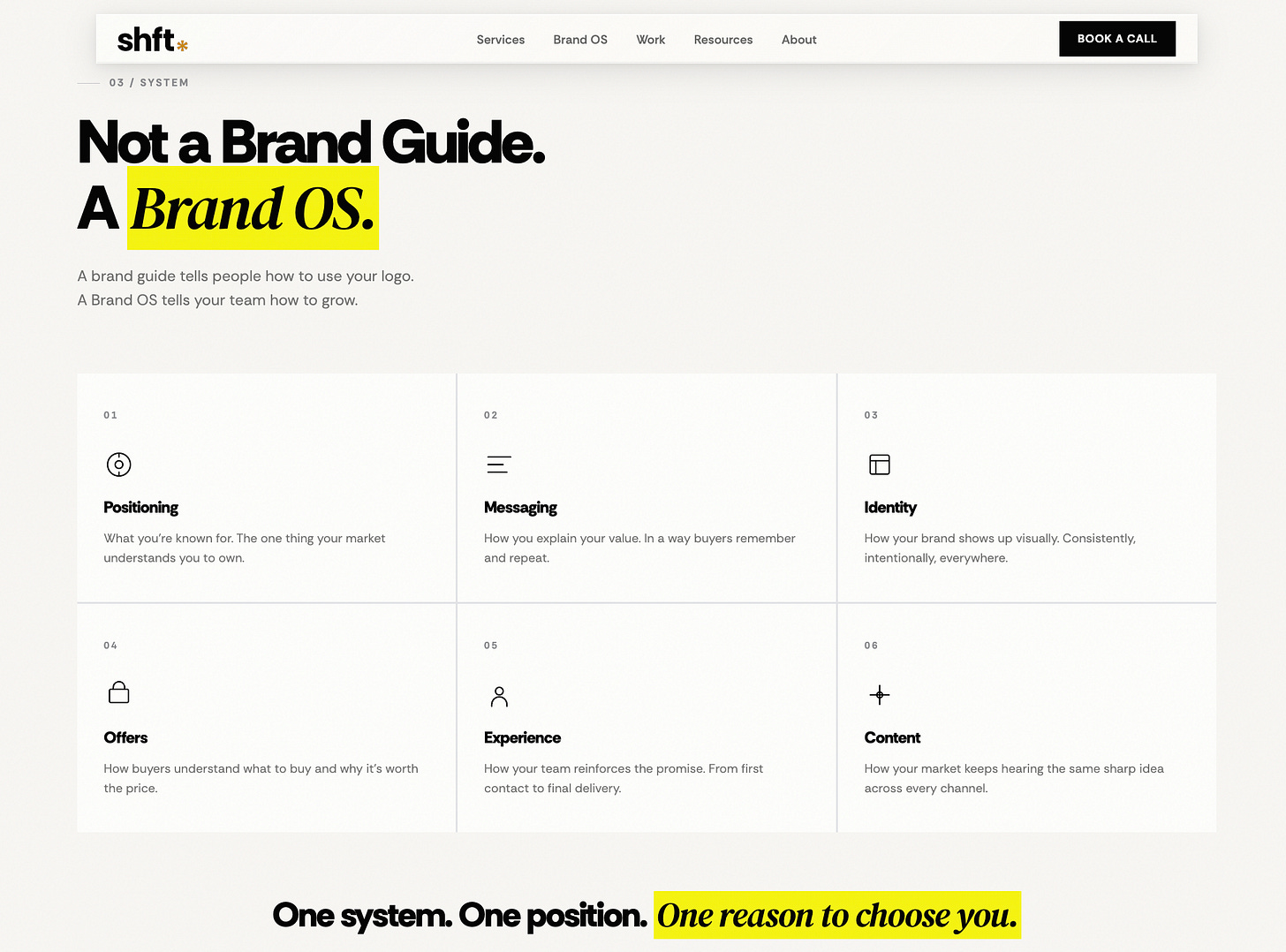
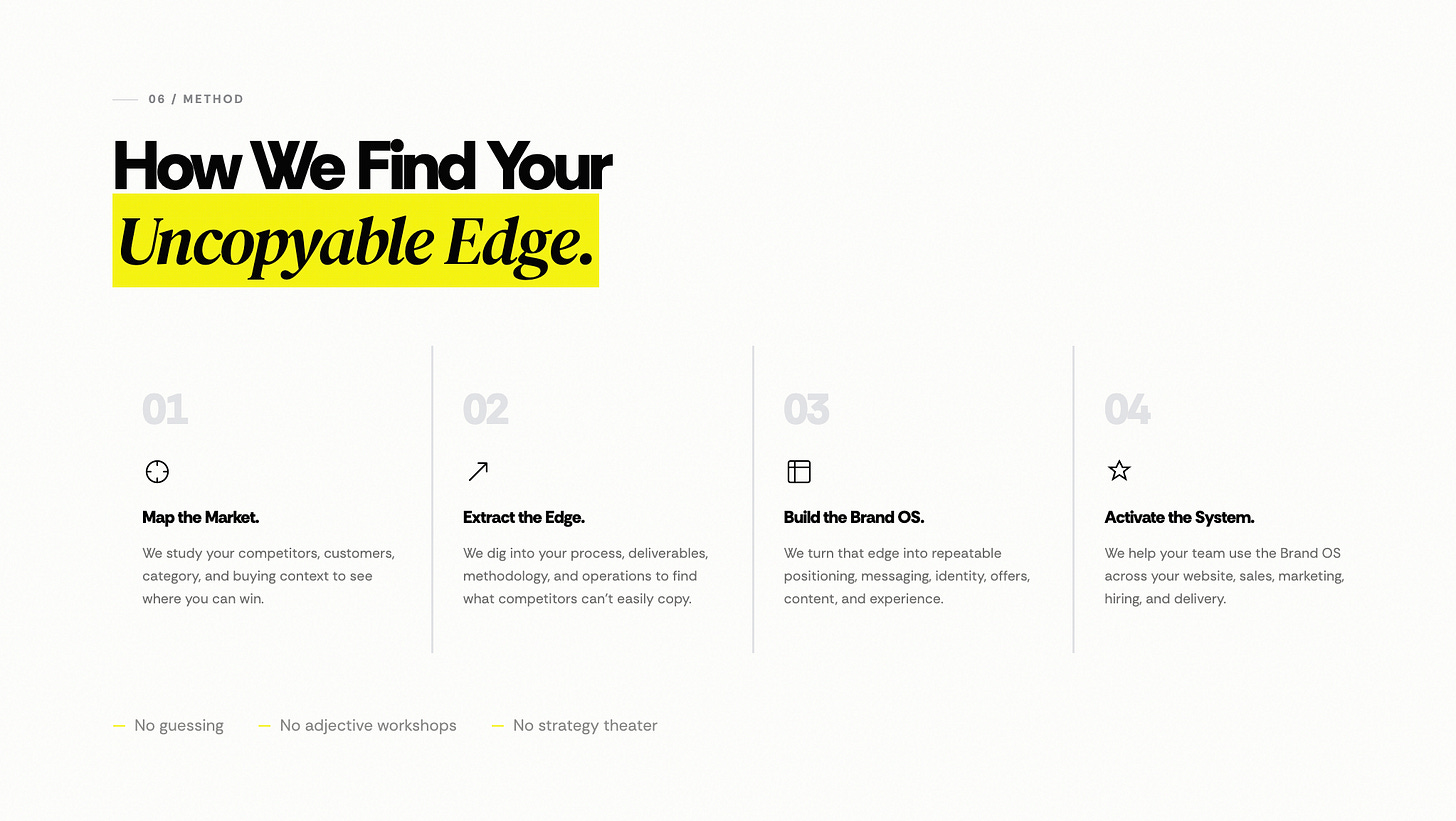
Or take a look at these sections of our (still in development) new website:
We use words like system, operating, and method instead of typical branding words like feeling, why, and purpose for a reason — they evoke the position we’re trying to hold.
The Shft Competitive Researcher Skill
Want a faster way to perform this research?
I took Sherman, our AI competitive research agent, and turned him into a skill you can use to research your competitors.
There are two versions of this skill:
- Basic Skill: requires nothing more than Claude Cowork to run, but may struggle to scrape websites and conduct SEO research at Sherman's level.
- Complex Skill: requires a Firecrawl API (paid) to scrape websites, YouTube API to scrape YouTube channels, Python scripts to discover new competitors, scrape websites, and access content assets, and a SEMrush subscription to pull SEO data.
You can choose which you want as you set up the skill.
Grab your copy for free here.
The folder includes instructions to walk you through setting it up and running it.
Reply to this email and let me know how it goes for you!
Until next week,
#SassyJason out.
✌🏼